

WHAT OPENS WHEN YOU STOP PUSHING
On Yin yoga, fascia, and the intelligence of stillness

The body keeps an accurate record of how long it has been asked to produce without being permitted to receive. Yin is, among other things, the settling of that debt— a practice designed to cultivate a restored capacity to receive sensation and develop literacy in emptiness.
Yin carries a vast philosophical history— threading an ancient way of reading the world through the connective tissue of the body, merging Taoism and physiology in a way that gives the practice unusual width and depth.
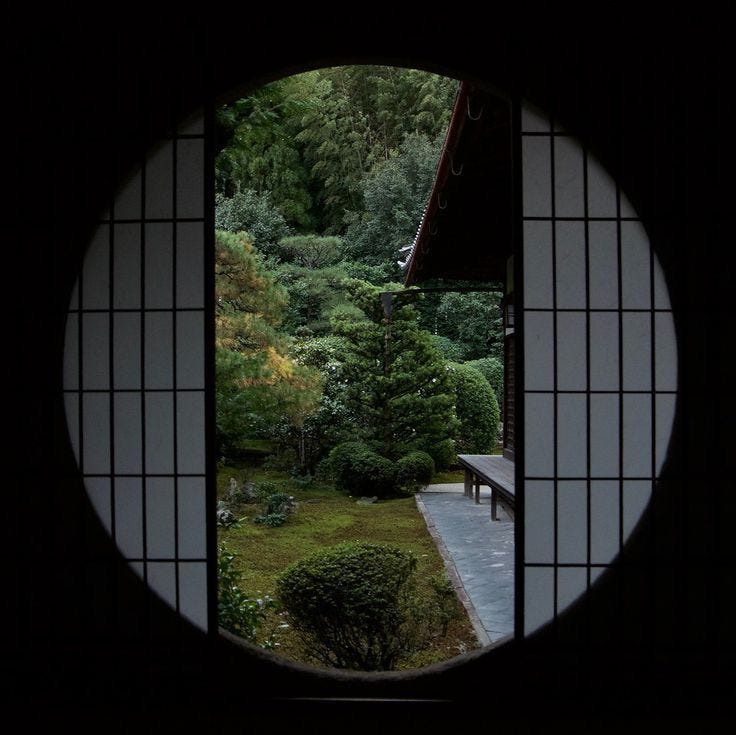
In classical Taoist thought, Yin and Yang are not opposites so much as conversational partners— complementary poles of a single continuous process. Yang is active, warming, dispersing. Yin is receptive, cooling, consolidating. It appears in the natural world as fog settling into the valley, coolness held beneath stone, the north face of the mountain where sunlight never directly falls. Not as poetic flourishes, but observational categories from a cosmology that understood balance as something you read in the landscape.
The river is viewed as one such demonstration. Its power is not in force but in yielding— finding the low places, moving with the grain of the land, carving its path with time and consistency rather than insistence. Yin yoga operates on a similar logic: the most efficient path is often the one that stops pushing.
Yin sequences work through longer-held, floor-based shapes, with reduced muscular engagement, and sustained attention. Holds last for three to five minutes— long enough for the deeper layers of the body to register and respond.
In any Yin hold, there is a margin— where the body's neglected terrain becomes suddenly arresting, a distinct taste. A weaving of sensation, stored history, and dense tissue. This is the most important territory in the practice, a golden band of gentle discomfort.
The sensory input causes a physiological cascade. Long-duration holds target connective tissues that respond to time rather than intensity. Fascia, ligaments, and joint capsules are viscoelastic: elastic enough to spring back from quick load, viscous enough to yield slowly under sustained tension. This gradual yielding is called creep— the tissue elongating beyond its initial resistance, the deeper layers reorganizing beneath the surface of stillness.
Fascia is the body's living web— not a passive wrapping but an active, highly sophisticated tissue that envelops organs, muscles, bones, nerves, and vessels in one continuous conversation. Nothing occurs in isolation; a shift in one thread moves through the whole. A shape held at the hip sends ripples through wider pathways.
Over time, with the inevitable calcification and wear of life, the fluid that allows fascial layers to glide begins to thicken and lose its fluidity. The result is the characteristic sensation of tissue that is not simply tight but no longer freely moving— two surfaces designed to slide, now claggy, reluctant.
With patience and consistency, sustained holds gradually remold the edges of density— causing a tangible response within the tissues, a quality of spaciousness, a softening categorically distinct from muscular release. Beneath the stillness, slow-adapting receptors in the deep fascia and joint capsules signal to the central nervous system, downregulating sympathetic tone and coaxing the tissues back toward hydration.
A Yin practice pries open a small but consequential gap between stimulus and response— drawing us into observation, physically untangling crystallized layers while learning to read sensation and our resistance to it. A few minutes into a hold, something gathers— a restlessness that moves through the body like weather, pressure building at the edges of the shape, the mind darkening toward the exit. Stay, and you watch it crest and dissolve.
To watch a reaction move through you without becoming it is to discover you are not that thought. Stillness makes the mechanics of reaction visible, giving us space to course-correct and intentionally shape the conditions we inhabit. Practiced consistently, this quality of attention sharpens interoception— and interoception, once refined, does not stay interior. The more accurately we can read ourselves, the more precisely we read our surroundings. Sensitivity, practiced, becomes fluency.
That capacity to read inward is, at its deepest, a seasonal intelligence. To live seasonally is to understand that expansion requires consolidation, that dispersal requires return, that the most intelligent thing a system can do at the height of its outward movement is remember how to come back in. Yin is that remembering— not passive waiting, but the slow underground accumulation that enhances outward movement and expression. Practiced not once, but across the full arc of the year, each season offering a different quality of excess and a different invitation to still. That yielding, as the river demonstrates, is not the absence of power.
TIPS FOR A YIN PRACTICE
CLOTHING
Wear loose, warm clothing. You want softness, not restriction— especially around your belly, ribs, and hips.
PREPARATION
Don’t practice on a full stomach. A simple rule: avoid eating for about two hours beforehand so stillness feels light rather than heavy.
TIMING
Practice later in the day, when your tissues are already warm— afternoon or early evening is ideal. Incorporate warmth, dim light, and soothing music.
FINDING AN EDGE
Choose a sensation zone, not a maximal edge. You want a mild-to-moderate sensation you can sustain for 3–5 minutes: enough that the tissues register load, not so much that the body braces, contracts, or pulls away from the opening.
USEFUL BASICS
Bolster (or a firm pillow)
Blanket
Optional: an eye pillow, socks, a second blanket for weight/comfort
…you might enjoy
SPRING YIN: CLEARING

A clearing, organizing yin practice designed to improve tissue glide and communication through the hips, inner thighs, and front body. Breath-led holds rinse the hips, widen the inner lines of the legs, and open the front body— reducing unnecessary tension without collapse. The emphasis is on circulation and restoring sensory clarity so information can move cleanly through the body.
BLUE LIGHT CLEANSING MEDITATION

This is a cleansing meditation informed by tantric principles of refinement. In yogic and tantric traditions, blue carries the quality of purification— not emptiness, but distillation. Simplicity makes clarity more distinct.
BREATHWORK: CLEAN BREEZE

A complete pranayama sequence designed to harmonize the hemispheres of the brain. Each phase has a distinct quality— cooling and receptive, warming and clarifying, balancing and releasing. Building toward a sense of systemic clarity and ease. A useful practice any time you need to reorganize and rebalance.